Start with the motion target
A laser cutting machine may care about rapid traverse, cutting positioning, repeat accuracy, and long stable running. The RFQ should state speed, accuracy, travel, load, cycle time, and whether the screw is a replacement, not just one specification.
One point is easy to get wrong: a ball screw is not the first choice for high-speed traverse. Laser machines rapid at tens of metres per minute, while a 1610 at 3000 rpm reaches only about 30 m/min; pushing rpm higher runs into the DN value and critical speed. High-speed machines therefore tend to use linear motors or rack and pinion on X/Y, with screws on the Z axis, focus adjustment, or medium-speed positioning axes. State the motion target and the supplier can tell whether this axis suits a screw at all.
Speed and accuracy need ranges together
Top speed alone is not enough: state the working speed, acceleration, positioning accuracy and repeatability too. A larger lead helps speed but changes resolution and thrust, and a higher grade affects cost and lead time. For grade differences, see rolled vs ground ball screw.
Speed converts quickly: at 1000 rpm a 5 mm lead runs 5 m/min and a 10 mm lead 10 m/min. Multiply by the target rpm.
Dust and heat effects belong in the first message
A laser cutting area may have fume, metal powder, coolant, or heat exposure. Dust protection, covers, cleaning method and lubrication conditions affect screw life, and they also decide whether special packing and pre-shipment photos are needed.
Heat can be estimated directly: steel expands about 11.7×10⁻⁶/K, so a 1 m screw rising 5 K grows by about 60μm. For an axis holding tens of microns, that is not negligible, which is why long axes are often pre-stretched, duty-cycle limited, or cooled.
Travel and support span drive stability
A long-travel laser machine has to watch support span, critical speed, end machining, and mounting straightness. Overall length, thread length, fixed side, support side and coupling end dimensions belong in the RFQ together.
Repair replacement needs old-part photos
For a laser machine repair replacement, provide old-part photos, nut style, end machining, support units, failure symptom, and machine axis. That is what decides whether to copy the old part, cut from standard stock, or re-confirm the end dimensions.
Application decision table
| Laser cutting condition | What to confirm | Why it affects quotation |
|---|---|---|
| High speed axis | Lead, support span, critical speed | Prevents vibration and unstable movement. |
| Accuracy-sensitive axis | Accuracy grade, backlash, repeatability | Connects motion performance to inspection. |
| Dust and heat exposure | Dust protection, heat effect, cover | Reduces contamination and deformation risk. |
| Long travel | Travel, total length, packing method | Affects manufacturing, support, and export packing. |
RFQ checklist
- Laser cutting machine type, axis, travel, speed, acceleration, and accuracy target.
- Support span, screw length, lead, load, guide structure, and motor connection.
- Dust protection, heat effect area, cover design, lubrication, and cleaning plan.
- End machining, support unit, nut style, inspection report, packing, and delivery target.
- Quantity, destination, shipment photos, and whether the order is repair or new equipment.
Send us the laser axis parameters
Send weimute the axis data, speed target, accuracy requirement, dust protection plan, and support span. Our manufacturing and sales team can check whether the screw route matches the machine's motion and environment before quoting.
FAQ
Is speed the only priority in laser cutting? No. Speed, accuracy, support span, dust protection, and heat effect must be balanced, and a high-speed axis may not suit a screw at all. See rolled vs ground ball screws for how grade fits high-speed laser axes.
Why mention packing for laser machine screws? Long travel screws are long and sensitive to bending, so the packing method sets the shipment risk.
How is thermal growth handled? Usually by pre-stretching, limiting continuous duty cycle, and improving lubrication and cooling. A higher accuracy grade does not remove thermal distortion.
Next step
Turn this guide into an RFQ
When the specification direction is clear, send the details below together with quantity, lead time, and packing requirements.
Include these details
- Model, diameter, lead, accuracy grade, or target application.
- Load, speed, travel, mounting method, and matching rail or support-unit needs.
- Quantity, lead time, packing, and whether inspection records or shipment photos are needed.
Category
Related Technical Guides
Continue with similar buyer questions
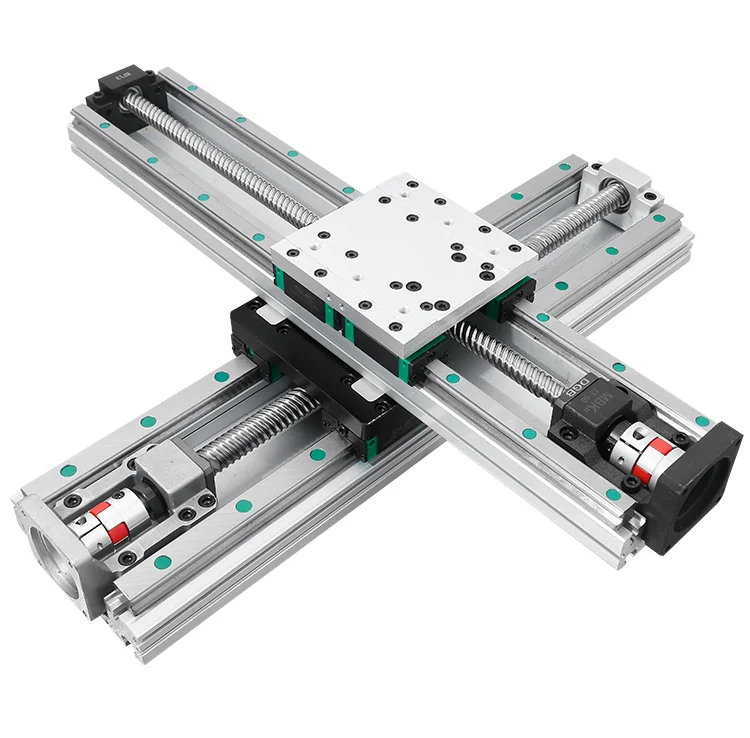
Linear Module Basics: Stroke, Load, Speed, and Accuracy Explained
State stroke, load, speed, cycle time, and accuracy together when selecting a linear module and requesting a quote.
Send linear module parameters
Rolled vs Ground Ball Screw: Differences and How to Choose
Choose rolled or ground by the machine accuracy requirement, then compare cost, lead time, preload, and the RFQ details that affect the assembly.
Send accuracy and application requirements
How Ball Screw Lead Changes Speed and Thrust
Compare how larger lead changes speed, thrust, and control margin, then list the axis parameters required before an RFQ.
Send lead and speed requirements