Selection
Linear Module Basics: Stroke, Load, Speed, and Accuracy Explained
State stroke, load, speed, cycle time, and accuracy together when selecting a linear module and requesting a quote.
Send linear module parametersProducts
Ball screw-driven linear modules, including compact G7×40 models, with matching motor mounts. Specify travel, load, and speed so the application and quotation can be checked.
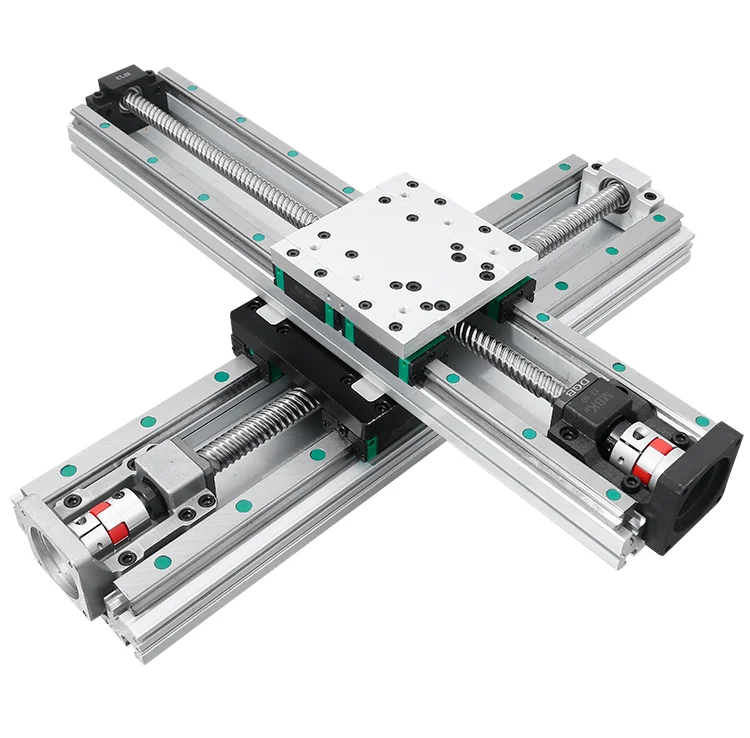
A linear module puts the ball screw, guide rail, carriage, support units, and motor mount on one base. The screw drives the slide, the rail and carriage carry the load and moments, the support units hold both screw ends, and the motor mount connects the motor and coupling to the screw end. You bolt the base down and connect the motor.
We quote ball screw-driven linear modules, including compact models such as G7×40, together with matching motor mounts. The ball screw, nut, guide rail, carriage, support units, and coupling inside a module belong to other product families on this site, so we can quote them with a module or as separate line items.
These modules suit positioning, transfer, inspection, and dispensing stations. Before quoting we check travel, load, speed, mounting direction, motor interface, and service plan, then confirm screw diameter and lead, rail size, and end machining. The technical guide section carries articles on stroke, load, speed, and accuracy, and on module RFQ parameters.
These items pull against each other. Travel alone does not size the screw and rail. Load alone does not set lead and speed. Send them in one message and the quotation can be checked in one round.
| Item to state | What it drives |
|---|---|
| 1. Travel | Module overall length, screw thread length, and mounting space. Overall length exceeds travel because both ends carry support units and the motor mount |
| 2. Load | Total mass, centre of gravity, offset or overhung weight, and acceleration, which set rail size, carriage count, and screw diameter |
| 3. Speed and cycle | Common speed, distance per move, cycle time, and running hours per day, read together with screw lead |
| 4. Mounting direction | Horizontal, vertical, or inclined. A vertical axis also needs a holding or brake requirement after power loss |
| 5. Motor interface and coupling | Motor type, flange size, coupling end diameter and length, keyway or flat, and whether a gearbox is used |
| 6. Limit and home switches | Whether they are needed, which side they sit on, and where the cable exits |
| 7. Replaceable screw inside the module | A replaceable design helps repair and spare-part stock, and it changes the nut housing and end machining |
| 8. Quantity and packing | Prototype quantity, batch forecast, and export packing or label requirements |
An assembled module saves integration work. The base is machined once for the rail mounting face and the screw support bores, so alignment happens before shipment. You fix the base, fit the motor, and set the switches. You deal with one supplier for delivery, and one drawing covers mounting holes and overall length. If the module fails, you swap the unit and shorten downtime.
Building from parts fits a different case. Your travel is unusual, or the machine already carries rails and supports and only needs a new screw. You order the screw, nut, support units, and coupling to your drawing, and add end machining. Replacement parts can be bought singly, which suits retrofits of older machines.
Three points decide the route: how many units you need, whether mounting space is tight, and how much downtime you can accept. For non-standard travel and tight space, confirm the screw and rail dimension chain first, then decide whether a machined base is worth it. If the screw inside a module has to be replaced, state whether you want a screw or a complete module, because the drawings and checks differ.
Write these eight items and the first email can go straight into review, without a second round of questions. Attach drawings, photos, and installation dimensions to the inquiry.
Technical Guides
Read selection, RFQ, machining, and packing articles for this product family before sending an RFQ.
State stroke, load, speed, cycle time, and accuracy together when selecting a linear module and requesting a quote.
Send linear module parameters
A linear module inquiry should describe the ball screw, slide, guide rail, motor connection, and repeatability together instead of quoting by model only.
Send linear module parametersProducts
A linear module rarely ships on its own. Buyers usually quote the screw, rail, support units, coupling, and linear bearings against the same machine list, so the product families below can be confirmed inside the same module inquiry.
Ball screws and matching nuts in SFK, SFU, SFWU, SFS, SFA, SFY, SFG, and straight S/U series. Specify the model, length, and quantity for a quote.
MGN/MGW miniature guides, HGR profile rails, and SBR supported round rails with matching carriages for machine builds, repairs, and distributor orders.
Rod-end bearings with male or female threads and spherical plain (joint) bearings for linkage joints, cylinders, conveyors, and automation machines. Radial, angular-contact, and thrust series, with self-lubricating liner options; custom shank lengths and threads available. Send your application and thread size for a quotation.
FAQ
Three questions buyers raise most often during selection.
The ball screw is the drive part inside the module. The module is the assembled unit with screw, rail, carriage, support units, and motor mount. If you build your own structure, order the screw and matching parts. If you want to cut assembly time, order the complete module.
We can start the review, but we also need load, speed and cycle, mounting direction, and the motor interface. Those items set rail size, screw diameter and lead, and end machining, so leaving them out delays the quotation.
It depends on the module design. Both screw ends carry support units and end machining, and the nut housing has to match. Send photos of the old screw, overall length, and end dimensions, and we will confirm whether a screw or a complete module is the practical route.
+8615268772262
Leave your question or requirement and we will continue in WhatsApp.
Continue in WhatsApp